MICHAELS I was telling my son the other day, I was like, if New York can fall and there's Sharia courts all over Texas, honey, I don't even know where there is to run anymore.
O'REILLY We've never seen this kind of radical left power play gain traction. They dismissed you as some kind of white supremacist or whatever
MICHAELS Yeah, well, she lied about it and manipulated the conversation, and she's like, You brought it up. I'm like I didn't bring it up, your guest just brought up.
MICHAELS Of course, half the country literally wanted to kill me.
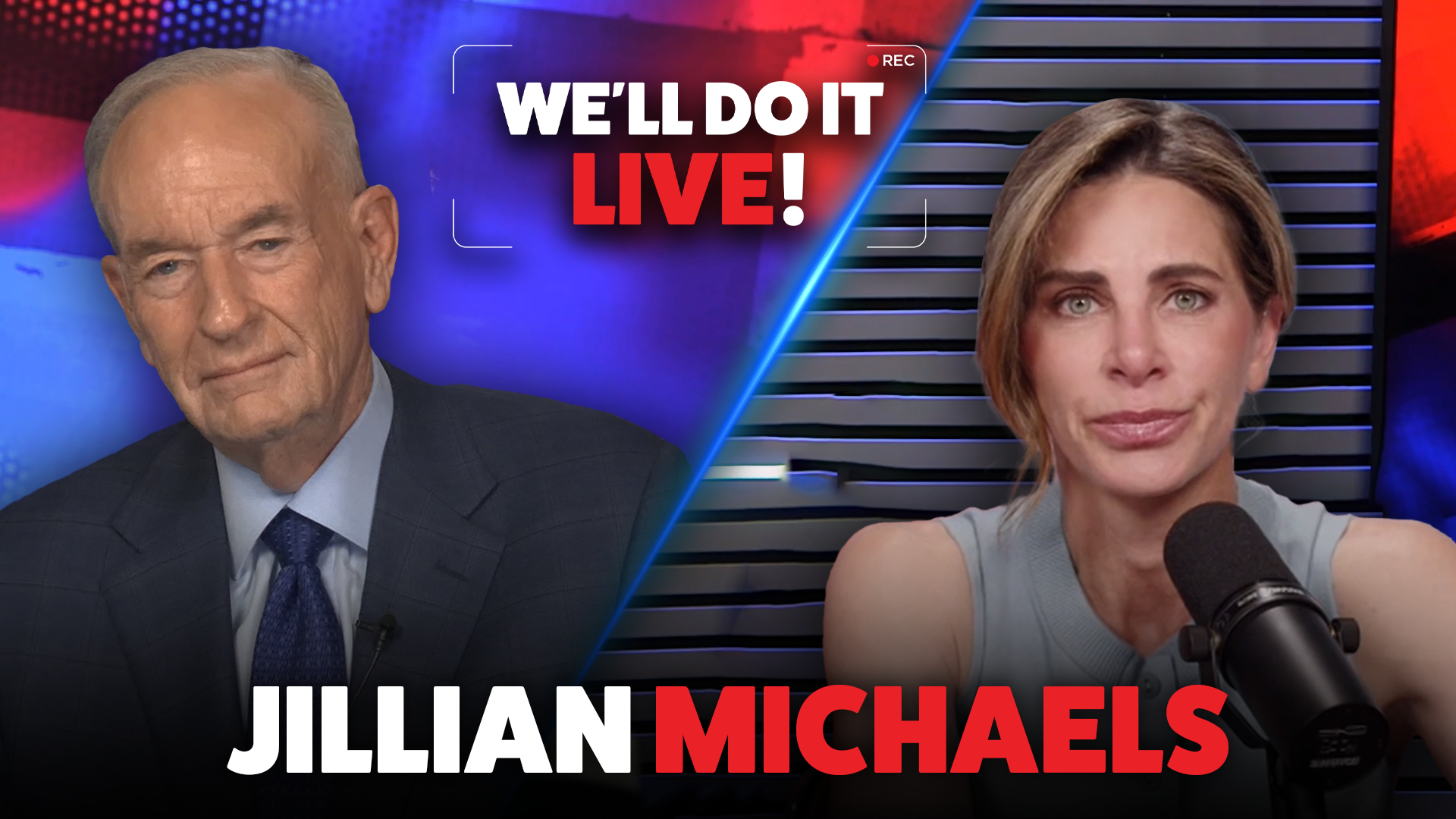
O'REILLY Bill O'Reilly here. Welcome to another edition of We'll Do It Live. And here now is our guest, Jillian Michaels. Now you know her, but you really don't. You really don't know her. But after this, you will. So what caught my eye about you as a person is that your upbringing, your mother was Jewish and your father Syrian. That is some combination. How did that play out in your house when you were a little kid?
MICHAELS You know, boss, I actually had no idea what any of that meant because my parents didn't raise me with a religion. They raised me as an agnostic and to be respectful of everybody, and I actually had no idea that I had Jewish blood until a genetics test at some point in my 30s, and here I was just thinking, you know, I'm Arab, and my mom's like a mix of Mediterranean, and I don't know what, and I thought her mom was British. And had, you know, become a war bride, married my paternal, my maternal grandfather during World War II. And that was that. And I, and all of a sudden I'm looking at my genetics going, wait a second, who's the Jew? And it turns out that my mom's mom had run from the Nazis through Russia into Austria, into the UK, and told my mom, don't ever tell anyone.
O'REILLY Why?
MICHAELS And she never did.
O'REILLY Why did she say that?
MICHAELS I think it was fear, and what's so ironic about that is for many years I remember thinking like, how crazy, what a completely different time, what totally different mindset. And now, for the first time in my entire life, I understand why she felt that way.
O'REILLY Yeah, I mean, but Los Angeles has always been known as a town that's fairly kind to Jewish people, and they run the film industry, or at least they used to, is a heavy component there. So when you were growing up, there was no prayer rug on your father. He wasn't invoking Allah, and your mother wasn't going to synagogue. They raised you strictly secular, is that correct?
MICHAELS Yeah, I think that they must have dealt with these issues before I was born, and it's one of the only things in my entire life that they have agreed on unilaterally. Again, I really didn't appreciate why that would be until now, but the one thing that I do respect and appreciate about it is that I was raised to respect all different religions. But it certainly takes on a whole new meaning in today's day and age.
O'REILLY Sure. Now, in our polarized society, but this is recent. So you're in Los Angeles. You're being raised as a California kid. Who was fleeing the Nazis? Your grandmother? Was it she was fleeing the Nazis?
MICHAELS Yeah, my mom's mom was fleeing the Nazis.
O'REILLY Okay, but you never were told the stories or anything like that. They kept that away from you.
MICHAELS Completely.
O'REILLY Okay, because we had Gene Simmons- I mentioned him earlier- his mother, herself as a young woman or child even, fled the Nazis, and that had a tremendous influence on Mr. Simmons, that whole thing. But you were in a totally different circumstance. Now, you adopted a daughter from Haiti, correct?
MICHAELS Yes.
O'REILLY And how old is she now?
MICHAELS She's 16 now.
O'REILLY 16! Wow!
MICHAELS Crazy, yeah. 16.
O’REILLY Now, I've been to Haiti a number of times, covered some pretty grisly stuff that went on there. How do you handle that one? Does your daughter, adopted daughter, know what Haiti is, know how you saved her? Because you literally did save her, that country's out of control.
MICHAELS I know. You know, the way that it's been positioned to her is that I wanted a child, all very true. And to be fair, God or the universe, fate, call it, give it whatever label you would like, led me to adopt internationally. And most countries were closed to international and Haiti was still open. Because she was born in 2010, that's when the earthquake happened, and we adopted her in 2012. So we just so happened to pursue adoption in Haiti because that country was still adopting out to the United States. So I position it to her as something that it is, she is a gift to me. I'm grateful every single day that she's in my life, but I have explained to her, because she has inquired about visiting, that it's not safe at the moment. And my hope is that one day she will take all of the gifts and all of the lessons and the education that she has gotten from being an American citizen and pay it forward to Haiti when she is older.
O'REILLY Okay. Is she aware of the history of the island that was shared with the Dominican Republic? Does she know, or do we kind of steer away from that?
MICHAELS No, she knows. And we've told her, you know, your ancestors were so powerful and so strong that they actually fought off the slave masters. You know, this is the stock that you come from. But this is a child that doesn't hold any of that multi-generational trauma because I don't have it to give to her. I'm not saying that's a good thing. I am not saying that's a bad thing. She has an understanding of the facts. But she also lives in the moment, and she loves being an American. She's not treated any differently than any of the other kids she goes to school with.
O'REILLY Do you, does she know you saved her?
MICHAELS I don't know, we certainly don't position it that way, you know what I mean?
O'REILLY I'm asking personal questions, but if you know Haiti as I do and you know the turbulence and the uncertainty that the population has to endure every single day, nobody is immune to it. And then you're in Los Angeles living an affluent life with Jillian Michaels. That's a big save. That's a big save, okay?
MICHAELS She definitely does not take the opportunities that being an American gives her for granted. She loves the country. She, she's an American kid. You know, she sees it that way. How she revisits her heritage as she gets older remains to be seen. You know I never want her to feel like she's beholden in any way because she isn't. This is a kid that lights up my life every single day. I don't know what I would do without her, but she is well aware that the country is in complete and total chaos and turmoil, yes.
O'REILLY Any skin color stuff come up? You know, she's, I'm assuming she's black, you're white, your wife is white. Any skin-color stuff at all in L.A.?
MICHAELS She's had a few, a few things happen, but they are few and far between, um, you know, she got into this is actually one of the first times I've heard about this. Very recently, she got into a fight with other teenage girls at her school, and apparently one of them told her to go back to her country. And I was irate when she told me that, and I was like, do you have any idea how much work we went through to make sure that this is your country? But she's like, mom, relax, it's totally fine. I can handle it. I'm just telling you what happened because you asked me about my day.
O'REILLY Yeah, kids are dopey. I mean...
MICHAELS Yeah, she didn't care. I was so pissed, but she didn't care at all, so...
O'REILLY The best way to handle that kind of stuff is by humor, but you have to make the overall point there are bigots, and there are ridiculous people running around, and we're never going to do away with them all. Now let's go to you. So when you were a kid, you're a little Zoftig, right? A little chubby, were you?
MICHAELS Oh yeah. Very, very. My dad always struggled with food. I definitely had his metabolism. Wish I could have gotten my mom's. This is a person that could eat whatever she wants and not gain a pound. But unfortunately, it went the other way in this instance. And in addition to that, one of the ways that we would bond and relate to each other was over food, so it's like, ah, the favorite. Shwarma restaurant, or my dad would make homemade ice cream, and we'd bond over that, and so by the time I was 13, I was about 175 pounds, and I'm only five foot two now, so I was probably five feet at the time.
O'REILLY So that must have caused you some social problems, particularly in a cosmetic place like Los Angeles or California, where you're evaluated on how you look.
MICHAELS Oh, unquestionably, but it did give me an appreciation for what it means to be an underdog and a huge amount of grit and resilience, and I wouldn't trade it.
O'REILLY How long did you stay chubby and then what was the conversion of getting out of that circumstance?
MICHAELS So, it was a confluence of factors that helped me get healthy. That happened when I was about 15, and my mom had the foresight to get me into martial arts, honestly, when I was around like 12 and a half or 13. She, you know what, she had been dating somebody whose nephews were in martial arts. She had a friend whose kids were in martial arts, and I was curious about it. And she thought, you know, maybe this will give her some self-respect, help her with her self-esteem, her self-image, and it did. It got me into a place where, over time, I gradually began to redefine my belief in my abilities and what I was capable of, and I began to learn about fitness and nutrition. So right around 15, I began to take the weight off, and by the time I was 17, I was pretty fit.
O'REILLY Were you an unhappy child up to the time that you got into the martial arts, or were you okay?
MICHAELS Complex upbringing, I would say, you know, nothing crazy, traumatic, I wasn't beaten, nothing, nothing like that. You know, ah, not a perfect childhood, not a terrible one. There were things that I had to work through, but again, those things made me who I am today, and they weren't so intense or difficult that I couldn't find my way out of them or that they did irreparable damage.
O'REILLY But it had to be a tough one going to school and the mean girls and all that. Were you able to swat that away, or did you incorporate it?
MICHAELS Okay, so the transition there happened after my second-degree blue belt test. I had to break these two boards with a sidekick. And I remember thinking there's no way I could do it. And at this point, I still had a nose the size of a softball, which got fixed when I was 15. Terrible skin, I'm heavy. And I break these 2 boards. I go to school the next day, and I'm just waiting for one of these mean girls to say something nasty. And no one did. And I began to appreciate that the way I thought of myself impacted the way I carried myself and the way I behaved. And when I respected myself, I ended up commanding respect from other people. And that was really the key shift.
O'REILLY And that was at age 15?
MICHAELS It was a little bit prior to that, probably around, like, 14. It was on the journey.
O'REILLY That's young, that's young for that kind of self-awareness to kick in.
MICHAELS I don't know, Bill, that I was aware of what was going on internally at the time. Looking back, I'm able to appreciate what was going on, if that makes any sense.
O'REILLY Okay. So then you take the martial arts thing, and you develop a fitness regimen, and you get on TV, which of course is in America, you know, that's it. You've got to get on TV. How did that happen? How did you get from Jillian Michaels, a martial arts person in L.A. to national television?
MICHAELS All right, I'm gonna try to make this quick because it's a bit of a long road. I graduated from high school early at 17 years old. Not because I'm a genius, but because my birthday fell on a strange date. So I was always the youngest in my class. I'm looking for a job. I'm delivering pizzas and parking cars. And I end up learning as I'm training for my black belt test that I can train people in fitness and make $15 an hour instead of five. So once again, my mom steps in. And she helps me get my first little fitness certification, and I begin training people. I'm in college, not doing well at it, end up dropping out after about a year and a half.
O'REILLY What school is that?
MICHAELS California State University, Northridge. And I'm making a bunch of money training people, I'm bartending at night now, get a little bit older. And I take it all for granted. And I just start making hand over fist cash at this point. I'm in my early twenties. Everything's great. Someone tells me I need to get a real job. I work in Los Angeles at the time. So, of course, I get a job in the entertainment industry. And I pull a David Geffen and a Michael Lovitz, and I fake a diploma. A little bit of sociopathy here, Bill, hopefully your audience will forgive me. I get hired into the training program at a talent agency called ICM. I've never been more miserable. And I've never made less money. However, it turns out that those connections I made at ICM were the ones that ended up putting me up for the job at NBC on The Biggest Loser. So, by 27, I'm miserable, I end up leaving the entertainment industry, I go back to fitness, I work at a sports medicine facility for a little while, learn that business, open my own sports medicine facilities by the time I'm 30, and all the doctors work under me for my business. And at that point, some of the people who knew me from back in my talent agency days put me up for this job at NBC, and I ended up getting it.
O'REILLY Okay, that's a logical progression. So you get the job. Now I didn't watch The Biggest Loser because I know so many losers that I don't want to be reminded in my leisure time of losers that are even bigger than the ones I know. Because I'm in the political game, talk about losers. Anyway, I didn't watch it, but friends of mine did. And the consensus is that sometimes you get a little mean to the hefty people who were coming before you. Is that true?
MICHAELS Depends how you would define mean, aggressive, yes, but you have to appreciate that Biggest Loser for me was a life or death intervention that I was running on a ticking clock because people could go home in a week, two weeks, three, and I needed them to have very specific, or hit very specific benchmarks before they would get eliminated, in order for there to be any hope of them continuing on their healthy journey.
O'REILLY Okay, so you were doing tough love, then, with these people.
MICHAELS Yes, a hundred percent.
O'REILLY Did you get letters saying, hey, you B word, why are you doing this?
MICHAELS Still do. Tons.
O'REILLY So you did. You got some pushback from the general public, because about 50%, I think, of Americans are overweight to some extent. And most people don't want to be overweight, but we live in a sugar culture here, which is really what drives this kind of crazy stuff. So you're on The Biggest Loser, you become a big star, and with these other reality people, and when you were there, you were for quite some time, let's see, you started in '04, and your last appearance was '13. So this is 9 years of The Biggest Loser. I would have committed suicide, but you got through it and prospered, right?
MICHAELS Somehow, I will admit that there is a great quote that I will butcher on the translation, but it is, that which nourishes me also destroys me. So I did manage to avoid suicide, and I am grateful for the platform because I wouldn't be sitting here with you today, but it definitely had its downs along with its ups, for sure.
O'REILLY Okay, so you know all of these reality shows play themselves out. I think there are now at least 400 people stranded on some island, and CBS ran out of money. So they're not coming back. I mean, it's like these reality shows are just...People watch them, and then they go, I've seen it. So you did what after The Biggest Loser lost?
MICHAELS Gosh, I spent a lot of time just building my fitness brand, writing books, creating fitness apps, investing strategically in other better for you companies, whether it was boutique fitness gyms or better for your food brands, like Crave Jerky, for example, or Pop Chips. And I was able to do really well for myself in that arena up until right around 2021, when the world went totally crazy. And I began exploring other areas and speaking to truth tellers like yourself, taking the audience on a journey with me to learn more about what in the heck's going on in our world today so that we can take powerful actions to try to honestly save the country is what it sure seems like, Bill.
O'REILLY It's hard, but you at the same time were running, you're an entrepreneur, you were running businesses, and it made it easier with the internet and social media for you to reach all these people. That's what I've done. So I got out of the straight television market, went right into social media, and boom, we've exploded because we have a product nobody else has. So, you're an entrepreneur, and you are making pretty good money. You're doing what you like to do, getting people in shape and all that. Now, today, we hear that people like you are the problem, that the socialist communist movement goes, wait, no, no. Jillian Michaels and O'Reilly, they make too much money. They don't have the right to make it. It's the country that did it, the government did it. They didn't do it. How do you react to that?
MICHAELS Well, I try to honestly take a more empathetic approach and seek to understand these kids who are so greatly disenfranchised because I have been poor, and I have been envious and jealous, but living in that headspace and focusing on the king of the hill instead of myself and what I need to do to get where I want to go was never productive. So I had great mentors that taught me to invert that jealousy and that envy into admiration and inspiration. And I flipped it in order to excel and get where I wanted to be in life.
O'REILLY All right, so you went up, but again, the money is coming in, you're living well, you're an affluent American, and now you have a movement that is demonizing wealth tax. They wanna go to Jillian Michaels' house and take your stuff. That's what they want, particularly in California. I mean, you would have to build a very, very big fence so you can at least get some of your jewels out before Newsom's cops come in and try to take everything. But you know what I'm talking about. That is new to our society. We've never seen this kind of radical left power play gain traction. So I'm just wondering, from an entrepreneur's point of view, you're an entrepreneur, how you how you're assessing it. You still live in California.
MICHAELS No, no, boss. I actually left in 21 because I saw the writing on the wall. I moved to Miami.
O'REILLY Oh, so you're a Floridian now.
MICHAELS Well, so I couldn't fully extricate members of my family that I have to be close to. So during COVID, the kids were able to go back and forth because they weren't in school for two years. My daughter ended up going to school in Florida. My son did homeschooling. And then when that ended, unfortunately, my ex didn't move, so I ended up getting a place in Wyoming, which is where I live now. I can get back to California in an hour and a half and go back and forth. I did not know you lived in Wyoming.
MICHAELS I do now, for about a year and a- two years? Two years now.
O'REILLY Beautiful state, but it's cold. It is cold in Wyoming, and then you get up every morning, you go out to get the milk, and there's a moose staring at you.
MICHAELS That's actually 100% accurate. It's the cutest thing in the world. But I'll tell you that it is well worth it. I can leave when I need to leave. Because honestly, Bill, I was telling my son the other day, I was like, if New York can fall, and there's Sharia courts all over Texas. If Florida goes down and Wyoming goes down. Honey, I don't even know where there is to run anymore. This has always been the place that people escape tyranny.
O'REILLY The red states will stay red, because there's so many people there that don't want the progressive point of view. That's why they're there. So anyway, I did not know you. I should have known it. My research should have told me. But I did know.
O’REILLY Have you ever grabbed seafood at the store, got home, and realized it did not live up to expectations? Wild Alaskan Company offers the best way to get wild-caught, high-quality seafood delivered right to your door on your schedule. Each box includes individually portioned vacuum-sealed filets that are easy to prep. Their seafood is quick-frozen after being caught in Alaskan waters, helping lock in texture and flavor. It's fish you can trust. No GMOs, antibiotics, or additives. While supporting sustainable harvesting. And Alaskan fishermen with a 100% satisfaction and money-back guarantee. So please go to wildalaskan.com/bill for $35 off your first order of premium wild-caught seafood. That's wildalaskan.com/bill for 35 bucks off your order, thanks to Wild Alaskan Company for sponsoring this episode.
O’REILLY So now you're kind of building up a portfolio of you appear on programs like mine and others. And you were on CNN Newsnight with Abby Phillip. Abby loves me. I mean, she just doesn't stop calling. She, you know, Abby just loves me, okay? That's a total lie, by the way. But anyway, so she's on there with you. And you guys are arguing about American slavery, about the roots of it and how it's displayed and which drives Trump crazy in the Smithsonian and other things. But in this society, if you are gonna take on a person of color about slavery, right away, okay, you're seven points down. And I was wondering what that experience was like.
MICHAELS Well, you know, Bill, it started out actually as a conversation about the Smithsonian. And one of Abby Phillip's guests, Julie Roginski, was making the claim that everybody whose MAGA is a racist and Trump was dear leader, like this authoritarian fascist, and I said that's not true. Because I had actually done my homework and reached out to the investigation, I'm sorry, to the administration, saying, listen, what is it that the president is taking umbrage with? And it had nothing to do with erasing slavery, and it had everything to do with demonizing white people. So, for example, there's a poster, or there was, in the Smithsonian about white culture that talks about how aggressive white people are. It was things of that nature. So I started to defend against that when Richie Torres and Abby Phillip began engaging in a conversation about slavery. And at that moment, I thought, okay, you know what? If we're gonna go down this road, let's go down this road. And I brought up the fact that slavery has been around for thousands of years, that every single race and ethnicity has worn the whip and the chains, and that it doesn't do our society any good to demonize just one race for all of the evils of all of humanity throughout the history of humanity. And you're right, it didn't go well on CNN, but I think a lot of other people appreciated the fact that I was challenging them on this topic and brought up a fact from the 1860 census that showed less than 2% of white Americans owned slaves. And of course, I understand that the entire South built an economy on it, but then the counterpoint is that the North didn't, and that the country went to war over it, and the 350,000 white people died to end it because they also found it abhorrent. And I don't understand why we cannot appreciate that, yes, these evil things happened, but that there were good white people standing alongside their white or their black brothers and sisters throughout the history of America, fighting for what was right as well. And until we can find this unity, I don't know how this ends, Bill. And I have a black kid, and I have a white one. And I think this begets more racism and more hatred.
O'REILLY You'd have to take a very charismatic leadership. Now, when you were making your fact-based case, okay, which is always the way to go on these crazy, it was not well-received on the panel. I mean, they thought they dismissed you as some kind of white supremacist or whatever term they used.
MICHAELS Yeah, well, she lied about it and manipulated the conversation, and she's like, you brought it up. I'm like, I didn't bring it up, your guest just brought it. And then she brought up chattel slavery, and she said, you're trying to say that in America, and I'm like, no, that's not what I said. You're mischaracterizing what I said. And it became like, and then she literally dined out on it for a week on her show, educating people about how the white supremacist Jillian Michaels got slavery wrong. And I have confronted her repeatedly on the facts and invited her on my show to debate them. But of course, you know, that hasn't happened.
O'REILLY No, she's not going to do it. She's a privileged woman of color, and whatever she says is right, and if you disagree with her, then you're not worthy. That's basically what it comes down to. But boy, when you get into these precincts, as you saw, emotions fly. I mean, all rationality goes out the ears. I was wondering what the reaction to you was. I don't know what the accessibility to Jillian Michaels is, but did you get a lot of heat from people?
MICHAELS Oh, goodness. Okay, well, of course, half the country literally wanted to kill me, literally, went after my wife, my kids, which is definitely par for the course. You know, I know you probably know this very well.
O'REILLY Did you have to get security like I do? Did you have to do that?
MICHAELS We've got, yeah, you know, the house, the dogs, the this, the that, the guns. Like we've, we got it all, which is kind of a gross and sad thing to say, but it's true. You know, but the other half of the country was like, thank God you said something.
O'REILLY All right, it's a divisional thing, right, right. Did you take solace from that, or where did you go, never again, I don't wanna get into this swamp?
MICHAELS This is one of the key conversations I think we need to be having, because if we don't, it's going to beget more racism from disenfranchised young white people who are feeling unfairly demonized for things they had nothing to do with and then become angry and racist. And I could give you many different examples. I think that's one of the good reasons that people like Nick Fuentes, who is a self-proclaimed white nationalist, has arguably one of the most successful podcasts in the world, I think this is why.
O'REILLY People believe what they want to believe. They often go to echo chambers to tell them what they already have incorporated. Now, you also left your podcast in 2025 under kind of, I didn't really understand it. It was doing very well. I was on it a few times. And you left it. Why?
MICHAELS Well, not my personal podcast. There was a podcast that Patrick Bette David had asked me to participate in that was called Her Take. And the idea was to have a group of women that had differing opinions. He wanted to bring a more common-sense version of The View to the masses. And it ended up very unfortunately getting to a place where, not because of PBD, by the way, just unto itself, because of the natural inclinations of the other hosts, getting to a place where it was dealing in conspiracy theories, and week after week, I would have to sit through my co-hosts discussing things like the Jews being responsible for 9-11, and the Jews being responsible for Charlie Kirk's death, and that's when I was like, This is not for me.
O'REILLY Right. I mean, you don't want to be involved with the loons, as I call them.
O'REILLY Are you being lied to? They tell you to max out your 401k and IRA, and then they make you beg to use your own money. It is time to get the truth and discover a better way to grow and protect your money. Bank on Yourself is the proven retirement plan alternative that banks and Wall Street desperately hope you will never hear about. You get guaranteed growth, tax-free retirement income, and peace of mind. You can get a free report that reveals how you can bank on yourself and access your money in retirement, enjoy guaranteed growth, have more control over your money. A Bank On professional will answer any of your questions. Just go to bankonyourself.com/bill, take back control of your financial future, bankonyourself.com/bill.
O'REILLY So now you're still a fitness guru, but you're also a political analyst to some extent, people seek out your opinion. Is that the way you want it? Is that balance you're looking for?
MICHAELS I don't see it that way, Bill. I'm the farthest thing from a political analyst. I see myself like I see my audience. We want to understand, we want to learn, I want the facts. And that's when I go to people like yourself, or people like Victor Davis Hansen, or people like Mike Baker, or politicians that are running for office, and I ask them questions. And the audience gets to hear those answers. And get that information, and form their own opinions about it. You know, if I do give an opinion on something that is considered political, it's because usually it's intersecting with health and my wheelhouse in the Venn diagram. So for example, I just did a press hit about the Supreme Court upholding Title IX because I owned a sports medicine facility and I've been a fitness expert since I was practically out of the womb So I can comment on that with unique expertise, or things on MAHA, for example, but stuff that falls into your wheelhouse, all I can do is ask the questions, honestly.
O'REILLY Alright, so you dabble in the public policy arena, but your core, to use a workout phrase, is still making people healthy. So enter Robert Kennedy Jr., who apparently eats roadkill and snakes. Should I be doing that? Should I? No? Appetizer? I don't have to get an entree of the boa constrictor.
MICHAELS You know, he might be a little eccentric. It's possible, but...
O'REILLY Talking about Kennedy, might be a little eccentric.
MICHAELS Listen, Bill, you know Xavier Becerra, obviously, right? This guy's probably going to be the governor of California. He's the one who previously held Kennedy's post, and this is a savage that tried to remove all age restrictions for gender-affirming care on kids. So Kennedy could eat frickin' the bark off of a tree filled with termites. And I wouldn't care considering the alternative.
O'REILLY Kennedy stays away from the trans stuff. Basically, he's a guy that doesn't like the vaccine, doesn't trust pharma. And the one message that has resonated with me is that he has a good view of if you poison your body with a whole bunch of sugar and carbs and you're eating his garbage, you're going to pay a price. So my son works out in the same gym as RFK Junior, and who, interestingly enough, and you should talk to him about this, wears jeans in the workout. No. No, you gotta, you gotta wear either the spandex or the shorts. But he wears the Wrangler jeans. And my son goes, why does he do that? I go, am I supposed to know everything? I don't know why. I don't know why he eats snakes. I don't know why he does anything. But anyway, he's good on the diet stuff, I think. But some of the other stuff is so out there that it erodes his message sometimes.
MICHAELS Here's what I would say. One of the things that Kennedy has spoken about that caused a huge amount of controversy was the suggestion that a chemical in our water called atrazine could be linked to why so many kids, or why the percentage of kids that are gender dysphoric or gay, could it be linked to this chemical in the water? Now, the reason that he was musing about this is because this chemical literally causes sex changes in frogs, and then, of course, everybody's like guys is a lunatic. He's a psycho. He is a crazy man, but what they should be asking is, wait, what in the hell is this thing in the water?
O'REILLY Yeah, but you gotta have science to back that up, plus Kennedy ate the frog, so we don't have the evidence. So the frog kind of disappeared. But I agree that I don't trust a lot of this supplement stuff that's being sold now. I think it's terrible for you and particularly mentally makes you out of your mind. His view, Kennedy's view, and again, he's not been nearly as bellicose, word of the day, as he was the first time or the first few months that he was in office. He kind of receded a little. I don't know why. I know him a little bit, he's always been respectful to me, even with the roadkill jokes. He seems to be able to process that. But we as a society now, we have a tremendous food industry, a lot of money, and they don't want any changes at all in the American diet, and diabetes is through the roof.
MICHAELS Yeah, I think, listen if I if I could speak candidly, in my line of work, the president has done some great things, and he's done some not-so-great things. Listen, he's working to cut out the middlemen, like the pharmacy benefit managers, to lower drug prices for people. He's got Dr. Oz working on dealing with pre-authorization problems that prevent people from getting the care that they need in a timely fashion. They've restructured the dietary guidelines so that food deserts will have healthier food and healthier food will be more cost-effective. I could give you a huge list of great things. I could give you a decent-sized list of things that are not so great, like giving immunity to Monsanto for glyphosate, which we know causes non-Hodgkin's lymphoma, or having Dr. Marty McCarey at the FDA push through flavored vapes, which were banned because he was concerned they would entice kids.
O'REILLY Right. I mean, it's ridiculous.
MICHAELS Yeah, there's good, and there's bad, but what I will tell you, and here's the thing, I worked with the Clinton administration in the health space, and I worked with the Obama administration in the Health space, and you know what got done, Bill? Nothing. Zero. So at least with Trump, we've won a bunch. We lost some, but we won some, and we never won any previously, So, I'm happy about it.
O'REILLY Yeah, I mean, it's a mystery because have you ever seen what the man eats? You know, he and Bobby Kennedy are friends. You said you bonded with your father over food? Because Trump, he likes the salt, he likes all that. But again, I mean, he's working hard. I don't care what he eats as long as, you know, we beat the Iranians. You can have five pizzas a day. I don't care, but I like the leadership in the sense that Americans are unaware, I think, of the most important part of their health, which is food. I think most of them are unaware of it. They don't know, and a lot of them don't care. They want to eat what they want to eat. They don't want O'Reilly telling them, what are you, the food police? My answer to that is, if I were you'd be in the penitentiary. So, anyway, I'm a pleasant guy at all times. We're going to stop now and let Jillian have a glass of water without anything in it that might turn her into a lizard. And then we will go on with our Premium and Concierge Membership. If you'd like to join, we'll enhance your life. You'll be under my protection. It's BillOReilly.com. So this is called Killing Time, and that'll come up just for Premium Members.
|